
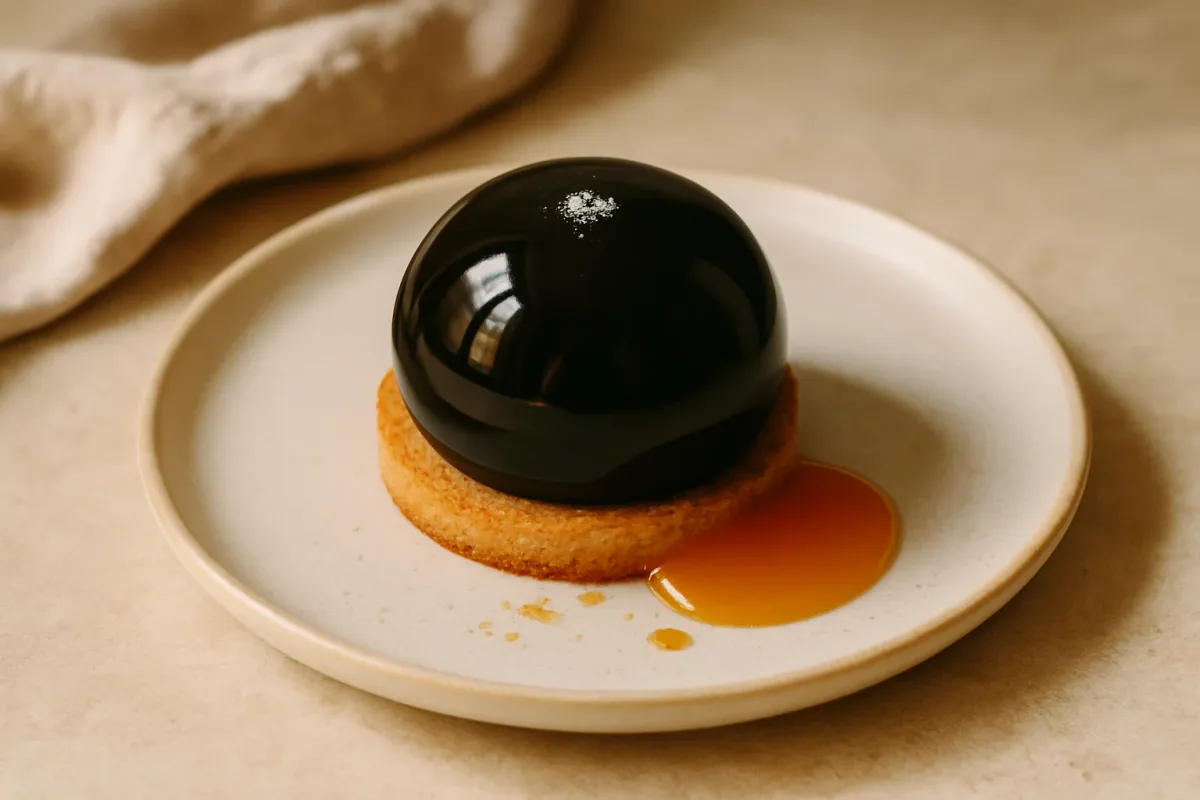
Noir Citrus Orb

Sign in to rate this recipe

Make this recipe your way, free
Grandmabot can adjust it for your diet, swap ingredients or change the servings. Free account, no credit card.
Ingredients
Instructions
- 1
Make the cocoa financier bases (do this first to cool while other elements set). Preheat oven to 180°C. Brown 150 g butter until nutty and amber; cool slightly. Sift 40 g flour, 180 g almond flour, 120 g icing sugar together. Whisk 120 g egg whites until frothy; gently fold dry mix and 50 g melted browned butter until smooth. Pipe thin rounds (≈4 cm) onto a silpat; bake 10–12 minutes until edges lift and surface is dry. Cool completely. These are the crisp base—keep in an airtight container.
- 2
Prepare candied orange gel insert. In a saucepan, combine 120 g fresh orange juice, 40 g sugar and 6 g orange zest; bring to a simmer. Bloom 2 gelatin sheets (≈4 g) in 20 g cold water for 5 minutes, squeeze and stir into hot juice until dissolved. If you prefer a slightly thicker gel, whisk 4 g cornstarch with 10 g water and briefly simmer into the juice before adding gelatin. Pour into a shallow tray to 4–5 mm thickness and chill until firm (about 1 hour). Use a small cutter (1.5–2 cm) to stamp 12 discs. Keep chilled.
- 3
Make orange‑blossom mousse centers. Bloom remaining 4 g gelatin (2 sheets) in 40 g cold water 5 minutes. Warm 160 g heavy cream in a saucepan until just steaming. In a bowl, whisk 60 g whole eggs with 30 g sugar until pale. Temper eggs by slowly whisking in a ladle of hot cream, then return mixture to saucepan and heat gently, stirring, until it reaches 82°C (thickens slightly) — do not scramble. Remove from heat, stir in bloomed gelatin until dissolved, then add 6 g orange blossom water and 3 g orange zest. Cool to ~30°C. Whip remaining 80 g heavy cream to soft peaks and fold gently into the custard to create a light mousse. Pipe into small dome molds to leave a small cavity for the candied gel disc; chill until set (2–3 hours or overnight).
- 4
Temper and mold the dark chocolate spheres. Temper 600 g dark chocolate using seeding or tabling method to glossy, stable temper (target working temp ~31–32°C). Lightly coat clean silicone half‑sphere molds (6 cm diameter) with chocolate—brush a thin even layer, chill until set, then add a second thin layer for strength. Remove from fridge briefly so shell isn't overly fogged, unmold halves carefully. Keep at cool room temperature away from humidity.
- 5
Assemble domes. Unmold mousse domes; place one chilled candied orange gel disc into each mousse cavity and top with a little extra mousse if needed to seal. Place mousse insert onto a financier base. Warm a rim of one chocolate half (briefly with warm spatula) and press around the mousse to form a closed dome; join two halves by warming the joining edge and sealing. Place domes seam-side down on a tray and chill 20–30 minutes to firm the chocolate seam.
- 6
Make black mirror glaze. Bloom 2 g gelatin (1 sheet) in 20 g cold water. In saucepan combine 100 g glucose, 120 g sweetened condensed milk, 160 g heavy cream and 40 g water; heat gently until steaming. Remove from heat and stir in 120 g finely chopped dark chocolate until smooth. Add bloomed gelatin and 15 g neutral oil for shine. Tint with black gel coloring to desired depth — start with very small amounts. Cool glaze to 30–32°C (warm but pourable).
- 7
Glaze the domes. Place domes on a wire rack set over a tray (to catch excess). Pour the warm mirror glaze evenly over chilled domes in one smooth motion so they are fully coated and glossy. Let excess drip; after glaze sets slightly, transfer domes to chilled plates. Use a fine brush to apply a tiny flourish of edible silver dust on one side for contrast.
- 8
Final plating. Place each glazed dome on a financier base (glue with a dot of warm chocolate if needed). Optionally pipe a thin orange zest curl or micro‑mint for color. Serve chilled but not ice‑cold — the interior should be soft so that dramatic reveal is liquid.
- 9
Service moment & reheating: For café service, keep domes cold; to create the viral reveal, pour a small ladle of warm (40–45°C) orange sauce over the dome tableside to accent the crack and flow. Alternatively, crack the dome with a small spoon to display the molten orange center. Best eaten within 24 hours; shells may soften over time if stored wet.
- 10
Production tips from Grandmabot: Keep your chocolate temper stable by working in a cool, dry room. Keep mousse and gel chilled before assembly to prevent sinking. Use thin, multiple chocolate layers for strong, delicate shells. The glaze pour temperature is everything — too hot and it will run; too cool and you’ll get orange peel texture. Don’t rush, dear — the drama is in the timing.