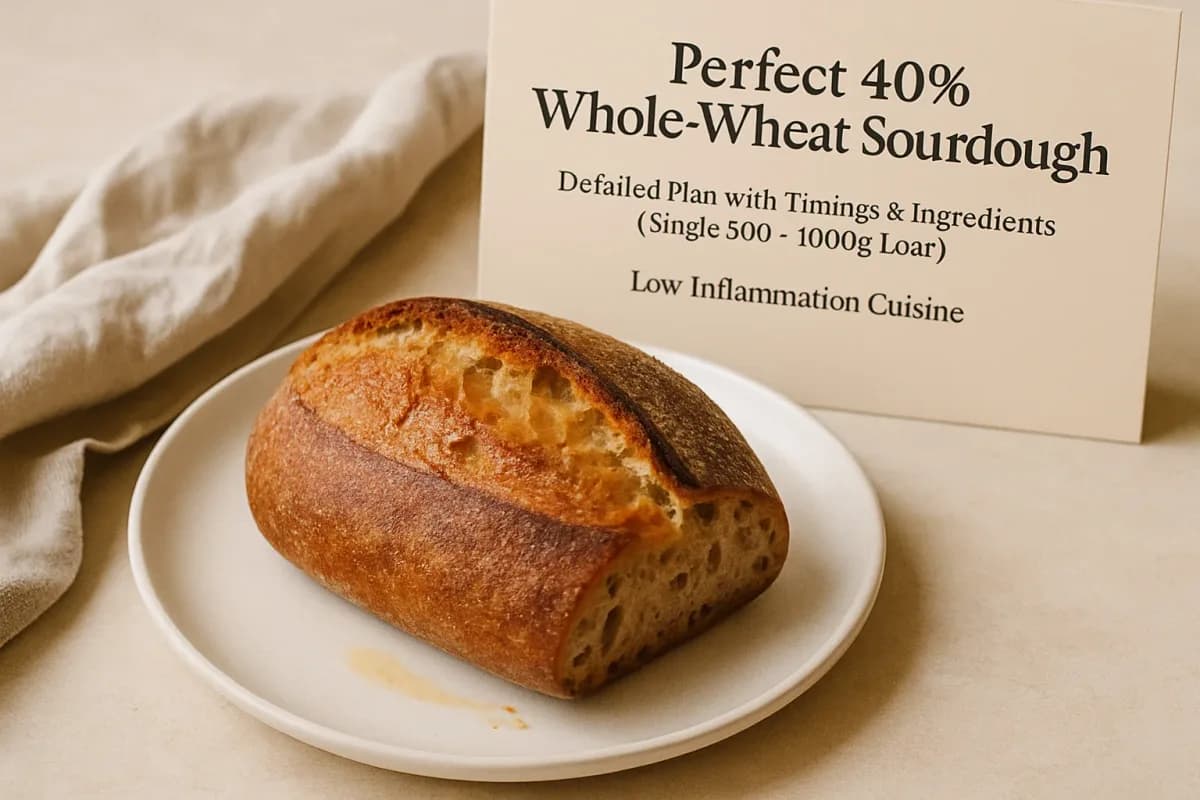
Perfect 40% Whole‑Wheat Sourdough — Detailed Plan with Timings & Ingredients (Single 900–1000g Loaf)

Inicia sesión para valorar esta receta

Haz esta receta a tu manera, gratis
Chef Andrew puede adaptarla a tu dieta, cambiar ingredientes o ajustar las porciones. Cuenta gratis, sin tarjeta.
Start time assumptions: you want a single loaf ready to bake the next morning. I’ll give a timeline with overnight levain build + autolyse day bake + cold retard option. Temperatures assume a comfortable kitchen ~24°C/75°F. Adjust times if your kitchen is cooler/warmer.
Totals (baker’s math)
- Total flour: 667 g (400 g bread flour + 267 g whole wheat)
- Hydration: 75% overall (500 g water)
- Levain: 150 g active (included in procedures below)
- Salt: 13 g (2% of flour)
- Olive oil (optional): 15 g
- Ground flaxseed (optional): 20 g
Final dough weight ≈ 1,135 g (pre‑bake), expected loaf weight ~900–1000 g after shaping.
Ingredients (exact)
- Bread flour (strong AP is ok): 400 g
- Whole wheat flour (freshly milled preferred): 267 g
- Water, room temp (~24°C/75°F): 500 g total (see breakdown)
- Active whole‑wheat starter (100% hydration): 50 g used to build levain; 150 g levain used in dough
- Fine sea salt: 13 g
- Extra‑virgin olive oil (optional): 15 g
- Ground flaxseed (optional): 20 g
Schedule Option A — Morning bake (levain night‑before; bake next day)
Day 0 — Night (11:00 PM) — Levain build
- 23:00 — Feed/build levain:
- Mix 50 g active starter + 50 g bread flour + 50 g water (100% hydration levain).
- Stir to homogenous, cover, leave at ~24°C.
- Expected peak: 4–6 hours (between 03:00–05:00). If your starter is very active, it may peak sooner. Aim to use levain when domed and bubbly but not collapsed.
Day 1 — Morning bake timeline (if levain peaks early, adjust to use when peaked)
-
07:30 — Check levain: it should be domed, bubbly, and pass the float test. If still young, wait until peak.
-
08:00 — Autolyse mix:
- In a large bowl, combine:
- 400 g bread flour
- 267 g whole wheat flour
- 480 g water (reserve 20 g water)
- 20 g ground flaxseed (if using)
- Mix until no dry flour remains. Cover and rest 45–60 minutes.
- In a large bowl, combine:
-
09:00 — Mix levain & salt:
- Add 150 g of the active levain (you built from 50/50/50; if levain peaked earlier, you may have a different weight—adjust: use ~150 g of active levain).
- Sprinkle 13 g salt over dough and add reserved 20 g water and 15 g olive oil (if using).
- Incorporate by pinching and folding until levain and salt distributed and dough becomes cohesive (3–5 minutes). Target final dough temperature ~24–26°C.
-
09:15 — Start bulk fermentation (total 3.5–4.5 hours depending on dough activity)
- 09:15 — First stretch & fold (S&F).
- 09:45 — Second S&F.
- 10:15 — Third S&F.
- 10:45 — Fourth S&F.
- After S&Fs, let dough rest undisturbed. Watch for ~30–50% volume increase and noticeable surface bubbles. Total bulk time ~3.5–4 hours; end around 12:45–13:15.
-
13:15 — Preshape:
- Turn dough onto lightly floured surface. Gently pre‑shape into a loose round, seam side down. Rest 15–20 minutes (bench rest).
-
13:35 — Final shape:
- Tighten into a boule or batard. Place seam‑side up in a well‑floured banneton or bowl lined with towel.
-
13:45 — Proof:
- Option 1 (same‑day): Proof at room temp ~2.5–3.5 hours until puffy (ready ~16:15–17:15). Bake same day.
- Option 2 (recommended): Refrigerate (retard) 10–16 hours. Place covered in fridge by 14:00 for bake next morning.
Day 2 — Morning Bake (if cold retard used)
- 06:00 — Preheat oven:
- Place Dutch oven or baking stone and tray in oven. Preheat to 500°F/260°C for 45–60 minutes for thermal mass stability.
- 06:30 — Score & load:
- Remove dough from fridge and invert onto parchment or preheated peel. Score with a sharp blade (~2–3 mm incision depth).
- Carefully load into Dutch oven (or onto stone, add steam).
- 06:35 — Bake:
- Immediately reduce oven to 450°F/232°C.
- Covered: 20 minutes (retain steam).
- Uncover: 20–25 minutes or until crust deep golden and internal temp 205–208°F/96–98°C.
- 07:20–07:40 — Cool:
- Remove loaf, cool on rack 2+ hours before slicing.
Notes on levain amounts and timing
- Levain weight: I suggest 150 g active levain in the dough; if your levain peaked and you have more/less volume, measure by weight. If levain is overripe (collapsed), it will be less effective—use fresh‑peaked levain.
- If your starter is less active, build levain earlier with warmer temps or use a higher inoculation (e.g., 1:1:2 starter:flour:water by weight).
Hydration adjustments
- If dough feels very sticky at mix time, reduce initial autolyse water by 10–20 g and add reserved water later.
- For a more open crumb, increase water to 510–520 g (78–78.5% hydration) and handle gently.
Troubleshooting quick tips
- Dense crumb: strengthen S&F, longer bulk, slightly higher hydration, ensure levain is active.
- Overly sour: shorten bulk fermentation or lengthen cold retard (mellow acids).
- Poor oven spring: underproofed (too tight in banneton) or weak