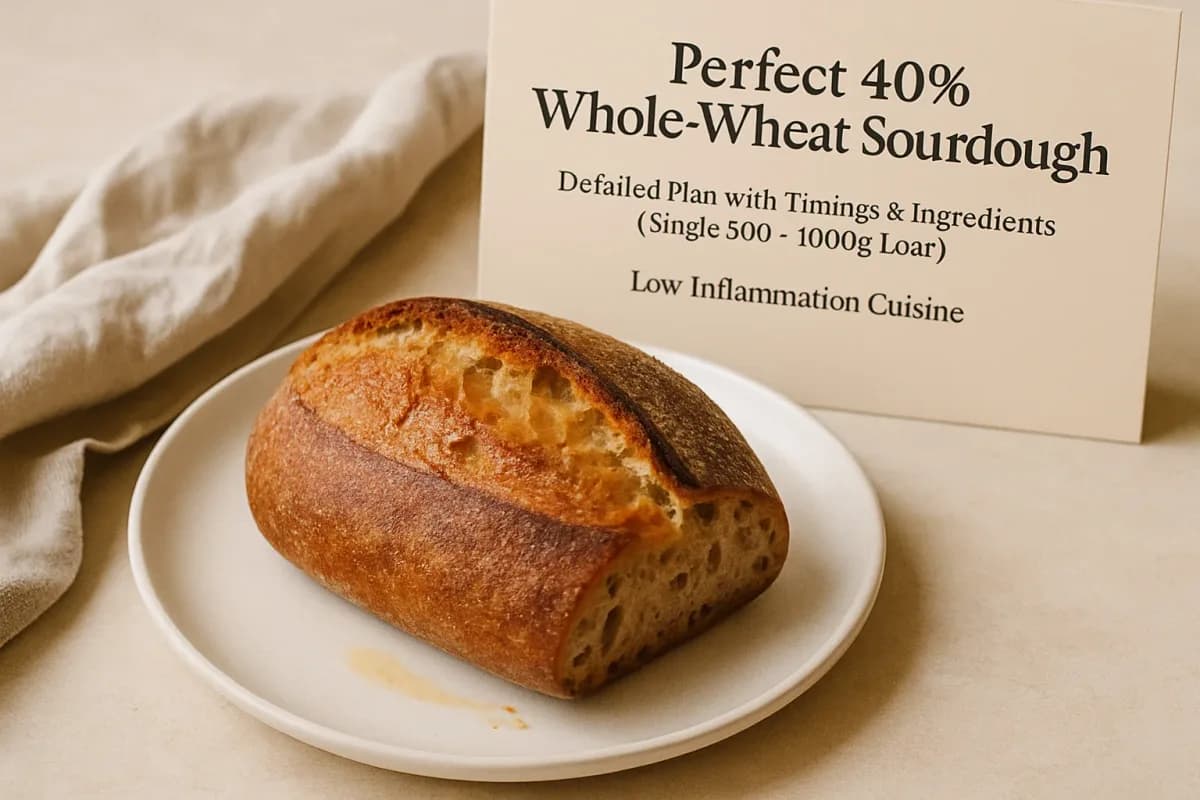
Perfect 40% Whole‑Wheat Sourdough — Detailed Plan with Timings & Ingredients (Single 900–1000g Loaf)

Sign in to rate this recipe

Make this recipe your way, free
Chef Andrew can adjust it for your diet, swap ingredients or change the servings. Free account, no credit card.
Start time assumptions: you want a single loaf ready to bake the next morning. I’ll give a timeline with overnight levain build + autolyse day bake + cold retard option. Temperatures assume a comfortable kitchen ~24°C/75°F. Adjust times if your kitchen is cooler/warmer.
Totals (baker’s math)
- Total flour: 667 g (400 g bread flour + 267 g whole wheat)
- Hydration: 75% overall (500 g water)
- Levain: 150 g active (included in procedures below)
- Salt: 13 g (2% of flour)
- Olive oil (optional): 15 g
- Ground flaxseed (optional): 20 g
Final dough weight ≈ 1,135 g (pre‑bake), expected loaf weight ~900–1000 g after shaping.
Ingredients (exact)
- Bread flour (strong AP is ok): 400 g
- Whole wheat flour (freshly milled preferred): 267 g
- Water, room temp (~24°C/75°F): 500 g total (see breakdown)
- Active whole‑wheat starter (100% hydration): 50 g used to build levain; 150 g levain used in dough
- Fine sea salt: 13 g
- Extra‑virgin olive oil (optional): 15 g
- Ground flaxseed (optional): 20 g
Schedule Option A — Morning bake (levain night‑before; bake next day)
Day 0 — Night (11:00 PM) — Levain build
- 23:00 — Feed/build levain:
- Mix 50 g active starter + 50 g bread flour + 50 g water (100% hydration levain).
- Stir to homogenous, cover, leave at ~24°C.
- Expected peak: 4–6 hours (between 03:00–05:00). If your starter is very active, it may peak sooner. Aim to use levain when domed and bubbly but not collapsed.
Day 1 — Morning bake timeline (if levain peaks early, adjust to use when peaked)
-
07:30 — Check levain: it should be domed, bubbly, and pass the float test. If still young, wait until peak.
-
08:00 — Autolyse mix:
- In a large bowl, combine:
- 400 g bread flour
- 267 g whole wheat flour
- 480 g water (reserve 20 g water)
- 20 g ground flaxseed (if using)
- Mix until no dry flour remains. Cover and rest 45–60 minutes.
- In a large bowl, combine:
-
09:00 — Mix levain & salt:
- Add 150 g of the active levain (you built from 50/50/50; if levain peaked earlier, you may have a different weight—adjust: use ~150 g of active levain).
- Sprinkle 13 g salt over dough and add reserved 20 g water and 15 g olive oil (if using).
- Incorporate by pinching and folding until levain and salt distributed and dough becomes cohesive (3–5 minutes). Target final dough temperature ~24–26°C.
-
09:15 — Start bulk fermentation (total 3.5–4.5 hours depending on dough activity)
- 09:15 — First stretch & fold (S&F).
- 09:45 — Second S&F.
- 10:15 — Third S&F.
- 10:45 — Fourth S&F.
- After S&Fs, let dough rest undisturbed. Watch for ~30–50% volume increase and noticeable surface bubbles. Total bulk time ~3.5–4 hours; end around 12:45–13:15.
-
13:15 — Preshape:
- Turn dough onto lightly floured surface. Gently pre‑shape into a loose round, seam side down. Rest 15–20 minutes (bench rest).
-
13:35 — Final shape:
- Tighten into a boule or batard. Place seam‑side up in a well‑floured banneton or bowl lined with towel.
-
13:45 — Proof:
- Option 1 (same‑day): Proof at room temp ~2.5–3.5 hours until puffy (ready ~16:15–17:15). Bake same day.
- Option 2 (recommended): Refrigerate (retard) 10–16 hours. Place covered in fridge by 14:00 for bake next morning.
Day 2 — Morning Bake (if cold retard used)
- 06:00 — Preheat oven:
- Place Dutch oven or baking stone and tray in oven. Preheat to 500°F/260°C for 45–60 minutes for thermal mass stability.
- 06:30 — Score & load:
- Remove dough from fridge and invert onto parchment or preheated peel. Score with a sharp blade (~2–3 mm incision depth).
- Carefully load into Dutch oven (or onto stone, add steam).
- 06:35 — Bake:
- Immediately reduce oven to 450°F/232°C.
- Covered: 20 minutes (retain steam).
- Uncover: 20–25 minutes or until crust deep golden and internal temp 205–208°F/96–98°C.
- 07:20–07:40 — Cool:
- Remove loaf, cool on rack 2+ hours before slicing.
Notes on levain amounts and timing
- Levain weight: I suggest 150 g active levain in the dough; if your levain peaked and you have more/less volume, measure by weight. If levain is overripe (collapsed), it will be less effective—use fresh‑peaked levain.
- If your starter is less active, build levain earlier with warmer temps or use a higher inoculation (e.g., 1:1:2 starter:flour:water by weight).
Hydration adjustments
- If dough feels very sticky at mix time, reduce initial autolyse water by 10–20 g and add reserved water later.
- For a more open crumb, increase water to 510–520 g (78–78.5% hydration) and handle gently.
Troubleshooting quick tips
- Dense crumb: strengthen S&F, longer bulk, slightly higher hydration, ensure levain is active.
- Overly sour: shorten bulk fermentation or lengthen cold retard (mellow acids).
- Poor oven spring: underproofed (too tight in banneton) or weak